News
Small Wind Turbines Take Off for Telecoms Sector
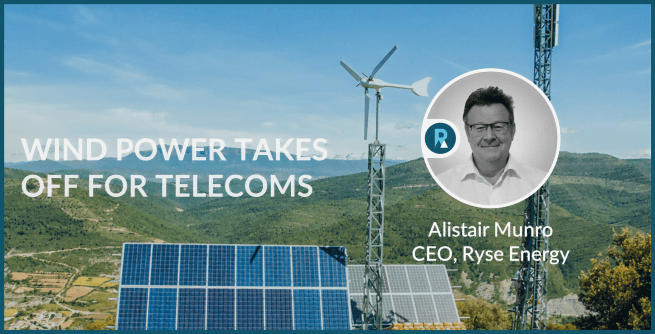
Ryse Energy is a proven supplier of wind power to the telecom sector where few other turbine suppliers have made inroads with the industry. In this interview TowerXchange speakers with Managing Director Alistair Munro about how Ryse Energy has made wind power work in Latin America, how it interacts with new sites and existing sites and the savings made possible by including wind power in a hybridised power system.
TowerXchange: Ryse Energy was formed out of a few different firms, what can you tell us about the firm’s history and origins?
Alistair Munro, Managing Director, Ryse Energy:
My background is in international large scale power and water projects, but from the 2000s I ended up involved in some power projects in Africa where it became self-evident that centralised power wasn’t working. Because of the failures in distribution, transmission, and the financing of large scale power, distributed generation had to be the solution.
Over the last five years Ryse Energy has grown to become a distributed generation specialist through a series of acquisitions of companies and intellectual property. In 2019 the various constituent businesses were merged to form Ryse Energy. Each company was successful in their own right, but by bringing together the core competences of each company, Ryse is now delivers more than the sum of its parts.
Ryse Energy is not just a wind turbine supplier. Yes, we do manufacture small wind turbines, but we are also committed to distributed energy. Wind is our core competence and route to market, but what we offer is energy management expertise, lithium-ion storage and solar hybrid power systems.
The telecom industry is a key part of our growth strategy. Taking our proven technologies into new markets.
We have 400 installations in telecoms applications. Typically these are 3-5kW machines, both on tower and off tower and hybridised with solar and battery storage. We work with Vodafone in Spain and Telefonica in Spain, Chile and Argentina. Wind seems to be better established in the Latin world than the Anglophone world, they seem to understand the efficiencies the technology provides and see the superior results a wind, solar, battery hybrid system can produce by reducing the amount of diesel consumed. Even for projects we have done for MTN in South Africa were done through a Spanish contractor.
TowerXchange: Briefly introduce your solution for telecom energy, and tell our audience what makes your solution different.
Alistair Munro, Managing Director, Ryse Energy:
When we began looking into distributed power for the telecom sector, and the stats were mind-blowing. The GSMA’s 2014 paper “The Global Telecom Tower ESCO Market” put total spend on diesel at cell sites at US$19 billion, with renewable hybrid systems potentially saving the industry over $13 billion per year.
That gives you quite a target to chase because there are many millions of installation opportunities.
Our solution targets the off grid and bad grid markets where so many billions of dollars of diesel is burnt unnecessarily.
Capex for these sites is low as diesel gensets are cheap, but the opex is very high. You do not just pay for the diesel burnt, but for pilferage, maintenance costs and fuel delivery. The industry is now seeing renewables as the future, and the viable alternative in terms of cost, resilience and sustainability to harmful diesel.
With the capital cost of solar dropping so quickly, it has rapidly become the technology of choice; because it is the easy choice. But the solar cycle means you will only produce power for 8-10 hours a day and then you have the issue of footprint where brownfield sites lack the space for solar PV arrays, and land costs near new urban greenfield sites may make it uneconomical.
The key advantage of wind power is the long production time of wind compared to solar, which enables you to downsize your battery storage on site or the ability for longer autonomy.
As solar and wind are complementary sources of energy, the strengths of each are able to balance the complete system, producing a more consistent supply of energy, and reducing the consumption diesel fuel to a minimum.
Another is maximising the value of your telecoms asset by using it to host a productive piece of power equipment. If you look at a 5-10kW installation you can be spending US$1,300-1,500 monthly on opex. On our fully hybridised sites that drops to US$150.
I would add too, that where I am in UK, you have lots of wind and also have a lot of bad grid areas. So this is not just for emerging markets.
Source: Ryse Energy hybrid renewables business case
TowerXchange: Wind energy for telecoms has yet to take off like solar or energy storage, what do you think has held it back so far?
Alistair Munro, Managing Director, Ryse Energy:
It’s a more technical approach. You have to consider certain structural factors if you’re looking for on tower installation. It is easier in greenfield installations, but for brownfield you have to look at tower aspects and how the turbine will interact with existing assets which have already been installed.
I also believe in the past, cheap poor-quality small wind turbines have burnt bridges for those like us, now paving the way in the hybrid renewables sector. These companies have now failed in the market. But with our proven and advanced small wind turbines, and our sector experience with over 4000 installations, we expect telecoms to be a key market for small wind turbines.
Furthermore, there is also a misconception regarding O&M.
Operating and maintaining our Ryse Energy small wind turbine technologies are minimal. Our technology is designed for a simple installation and spare part exchange. Some of our turbines have been running for more than 30 years now, so they are built to be resilient.
Looking ahead, the economics are going to be the driver for the introduction of wind into the telecoms sector, when people see the benefits of the economics they will adopt it.
Source: Ryse Energy hybrid renewables business case
TowerXchange: Your solution is already live in Spain, Argentina, Chile and South Africa; what can you tell us about the financing of your solution versus a typical energy set up?
Alistair Munro, Managing Director, Ryse Energy:
If you can get a payback in ownership cost in 2-3 years then you are looking at a good investment.
We see the telecom sector as a very bankable industry, so it may be that the best way to introduce a new technology is to go down an off balance sheet approach. These assets are very fundable because we have 4,000 sites live worldwide already and there is limited technology risk. We have over 400 telecom installations already so we think towercos will understand the benefit.
For ESCOs, our other key market in telecoms, they will want to look at the benefit of the technical offering, because their model already includes financing capex. Because of the reduction in opex with our solution they will be getting a 2-3 year payback and they’ll be interested in investing.
TowerXchange: You have experience in developed and developing markets; how your solution versioned for the different circumstances on the ground?
Alistair Munro, Managing Director, Ryse Energy:
There is little difference between the systems for developed or developing markets.
In developing markets where the volume of new tower installations is large we are planning to get our solution built into the original tower design, so the turbine is part of the package from day one. This reduces the overall energy cost of the structure. We are doing site trials ahead of major rollouts in some countries so that we can encourage its adoption as the standard approach.
In more mature markets, our approach is slower because we don’t have the volume of new installations. The technology solution is not too different but the approach to market is different where we must retrofit existing sites.