News
How the telecom sector can cut operating costs and help MENA become a renewable energy leader
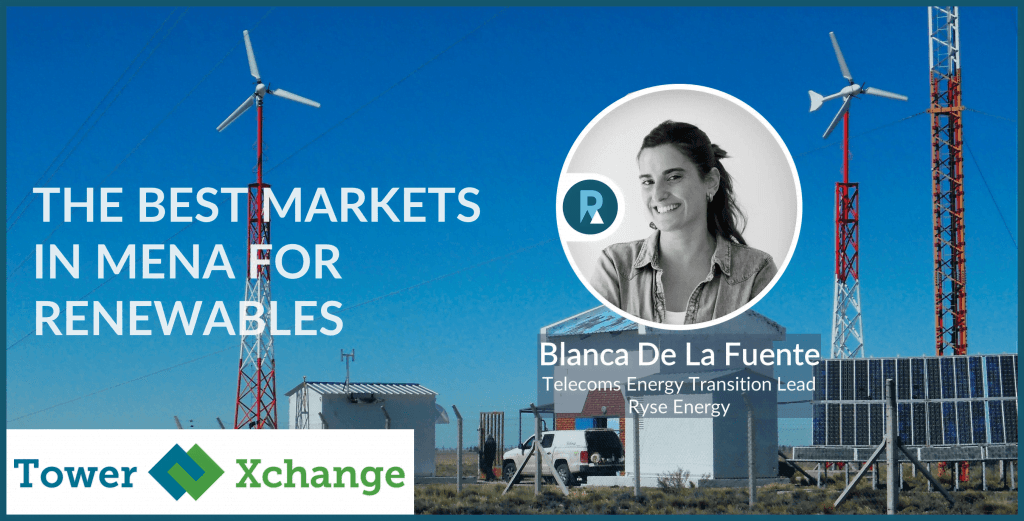
Ryse Energy is a proven supplier of wind power to the telecom sector where few other turbine suppliers have made inroads with the industry. In this interview TowerXchange speaks with Blanca De La Fuente, Telecoms Energy Transition Lead at Ryse Energy about the suitability of the Middle East for renewable energy and how they are helping to equip the region with the right technology to to cut costs and reduce emissions.
TowerXchange: Will you please introduce Ryse Energy and what makes you different from other hybrid energy suppliers?
Blanca De La Fuente, Telecoms Energy Transition Lead, Ryse Energy:
Thanks Matthew. Ryse Energy is global renewable energy technology company, focused on reducing operating costs and greenhouse gas emissions, whilst maintaining energy resilience on-site.
The company works across a variety of critical infrastructure sectors, and so we understand the need of high up-time requirements for the telecoms industry. What makes us different is we can maintain resilience and reliability, whilst enabling higher utilisation of renewable energy than other suppliers, which means lower operating costs.
We do this through hybrid renewables. Our unique wind turbine technology, which we have over 4,000 installations across all seven continents, coupled with an optimised solar PV design, energy storage, and emergency diesel backup. We use hybrid renewable energy systems to harvest the maximum available site energy reducing drastically the requirement for diesel.
We are also agile in the ever-evolving telecoms market, serving MNOs, towercos and ESCOs.
We can be a technology supplier. As we are a primary manufacturer of our advanced small wind turbines in the UK, Spain, and soon India and the UAE, we can integrate our renewable solution in to existing or new build sites.
We can be an energy provider. Utilising our optimised space designs and technologies to provide energy as a service to reduce capex whilst reducing opex.
We are modular in our design process. It isn’t a one size fits all. We’ve installed our 5kW E-5 wind turbine on-towers, off-towers, on-grid, off-grid. We’ve installed our 20kW E-20 wind turbine where demand was high. We’ve installed solar on-tower, solar off-tower. The configurations are endless, but what is consistent is the results.
TowerXchange: What elements contribute towards making a country or region well-suited to hybrid power solutions for telecoms?
Blanca De La Fuente, Telecoms Energy Transition Lead, Ryse Energy:
As a company based in the MENA region, in the UAE’s capital Abu Dhabi, we are very familiar with the regional telecoms landscape.
In terms of energy resource, the MENA region has a vast supply of wind and solar irradiance, coupled with the high number of remote and off-grid sites, and has huge potential for decarbonising the telecoms sector.
Saudi Arabia is a major MENA market with strong renewables resources, and with TAWAL’s presence in the region, the towerco market in the Kingdom is emerging and may disrupt the wider GCC status quo. TAWAL has new build sites, and with new sustainable cities such as NEOM being built from scratch, wind, solar PV and energy storage will play a crucial role in the telecom energy market.
In Oman, the potential for wind turbine deployment to reduce operating costs are huge. We have analysed multiple sites in Oman and the payback period for MNOs, towercos and ESCOs is just a few years.
We’ve seen progressive investment in Egypt’s tower infrastructure, and with more rural locations opening up as the country expands, this will require innovative solutions to keep up with power demand off the grid.
The UAE has two major operators and both Etisalat and Du are committed to greening the network through their various initiatives.
In Iraq, we are actively involved in bringing down diesel costs for MNOs. We have some interesting projects in the pipeline using 20 kW small wind turbines with solar PV to displace diesel.
Pakistan represents a big opportunity for renewable energy technologies. With unreliable, intermittent grid, coupled with big towerco players a large new tower roll out, it is a market we are very excited about its potential.
TowerXchange: You mention Saudi Arabia. As it is one of the largest markets in the region, could and oil & gas powerhouse like Saudi Arabia make a good home for renewable energy for telecoms?
Blanca De La Fuente, Telecoms Energy Transition Lead, Ryse Energy:
Having worked in the Kingdom for a number of years – we are very similar with the market and are very active in-country.
Whilst Saudi Arabia’s oil reserves are vast, so are is natural energy resources such as wind and solar.
Renewables is no longer just a sustainability or CSR decision. It’s a financial decision.
Perhaps the business case might be challenging on-grid, but in a country so vast the off-grid business case is simple. Utilising small-scale wind, solar PV and energy storage, telecoms companies are turning their off-grid locations green, and saving in some circumstances over 90% in fuel operating costs, whilst reducing in their carbon footprint in the process. This makes the choice to implement off-grid hybrid renewables a simple one when the cost reductions are so staggering. Making a green decision, an economical decision.
TowerXchange: The Middle East is well known for its sunshine and heat, but where in the region is suitable for wind deployments?
Blanca De La Fuente, Telecoms Energy Transition Lead, Ryse Energy:
We have over 10 wind turbine technologies we manufacturer, from 3 kW, up to 60 kW per turbine. Our turbines are diverse, across vertical and horizonal axis, and all three classes of wind speed so we are agile to every wind environment and power requirement. The Middle East, usually associated with oil, gas, and solar, is in fact a hidden gem for wind resource. As you can see from the data provided it the region has excellent wind.
Saudi Arabia is extremely well placed for wind energy deployment for the telecoms sector. The remote and rural locations across the country which are off-grid, coupled with the network expansions and
As briefly mentioned, Oman’s wind resource is superb. Not just in the mountainous regions but coastal and cities areas.
Egypt, Kuwait, Iraq and Yemen all offer wind reso